What Is a Characteristic of Baroque Architecture? Art in World Cultures
Italian Architecture in the Bizarre Period
The highly theatrical Baroque architectural style dominated Italy in the 1600s.
Learning Objectives
Define the characteristics and examples of Roman Baroque architecture
Key Takeaways
Key Points
- Bizarre compages was linked to the Counter- Reformation , celebrating the wealth of the Catholic church building. It was characterized past new explorations of form , light and shadow, and dramatic intensity .
- Bernini was the master of Baroque architecture in Rome ; St. Peter's Square was i of his greatest achievements.
- Carlo Fontana became Rome'south leading Baroque builder following Bernini'due south decease in 1680.
- Other influential Baroque architects in Italy included Carol Maderno, Pietro la Cortano, and Francesco Borromini.
Cardinal Terms
- Counter-Reformation: The period of Cosmic revival beginning with the Quango of Trent (1545–1563) and ending at the close of the Thirty Years' War (1648); sometimes considered a response to the Protestant Reformation.
- Baroque: A period in western art from c. 1600 to the middle of the 18th century, characterized past drama, rich colour, and dramatic contrast between low-cal and shadow.
The Bizarre Period in Italy
The Baroque period of architecture began in the late 16th century in Rome, Italy. It took the Roman vocabulary of Renaissance architecture and used it in a new rhetorical and theatrical fashion, often to express the triumph of the Catholic Church and the absolutist country. Information technology was characterized by new explorations of form, light and shadow, and dramatic intensity.
Whereas the Renaissance drew on the wealth and power of the Italian courts and was a alloy of secular and religious forces, the Baroque was, initially at to the lowest degree, directly linked to the Counter-Reformation, a movement within the Catholic Church building to reform itself in response to the Protestant Reformation . Baroque architecture and its embellishments were on one hand more accessible to the emotions and on the other hand, a visible statement of the wealth and power of the Catholic Church building.
Architectural Accomplishments
A number of ecclesiastical buildings of the Baroque period in Rome had plans based on the Italian paradigm of the basilica with a crossed dome and nave , just the treatment of the compages was very unlike than what had been carried out previously. Ane of the offset Roman structures to break with the previous conventions of the Mannerist style was the church of Santa Susanna, designed by Carlo Maderno. The dynamic rhythm of columns and pilasters , central massing, and the protrusion and condensed key ornamentation add complexity to the structure. There is an incipient playfulness with the rules of classic blueprint, simply it still maintains a level of rigor.

Facade of Santa Susanna by Carlo Maderno: The design elements of this church signaled a deviation from the prevailing Mannerist style of architecture at the time.
Pietro de Cortona
The same concerns with plasticity, massing, dramatic effects, and shadow and light are evident in the architectural work of Pietro da Cortona, illustrated by his design of Santi Luca e Martina (of which construction began in 1635) with what was probably the first curved Baroque church building façade in Rome. These concerns are fifty-fifty more evident in his reworking of Santa Maria della Pace (1656–8). The façade of the building, with its chiaroscuro half-domed portico and concave side wings, closely resembles a theatrical stage set and projects forward then that it substantially fills the tiny trapezoidal piazza .

Santa Maria Della Pace: Pietro da Cortona restored the edifice of Santa Maria Della Step, calculation a Baroque façade.
Gian Lorenzo Bernini
Other Roman ensembles of the Baroque and late Baroque period are as well suffused with theatricality and, equally urban theatres, provide points of focus inside the surrounding cityscape. Probably the most well-known example of such an approach is Saint Peter'due south Square, which has been praised every bit a masterstroke of Baroque theatre. The piazza, designed by Gian Lorenzo Bernini, is formed principally by two colonnades of gratuitous-standing columns centered on an Egyptian obelisk . Bernini'south own favorite blueprint was his oval church of Sant'Andrea al Quirinale, decorated with polychome marbles and an ornate gilt dome. His secular architecture included the Palazzo Barberini (based on plans by Maderno) and the Palazzo Chigi-Odescalchi (1664), both in Rome.
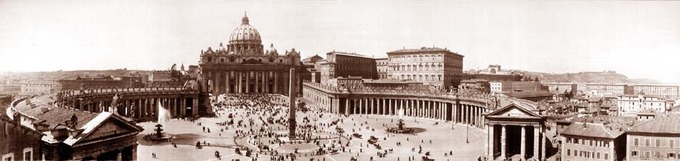
St. Peter'south Square by Gian Lorenzo Bernini: St. Peter'southward Square is an iconic case of Baroque theatricality.
Francesco Borromini
Bernini's rival, the architect Francesco Borromini, produced designs that deviated dramatically from the regular compositions of the aboriginal world and Renaissance. His edifice plans were based on circuitous geometric figures, his architectural forms were unusual and inventive, and he employed multi-layered symbolism in his architectural designs. His iconic masterpiece is the diminutive church of San Carlo alle Quattro Fontane, distinguished by a complicated plan system that is partly oval and partly a cross, giving it circuitous convex-concave wall rhythms.
Carlo Fontana
Following the death of Bernini in 1680, Carlo Fontana emerged as the most influential architect working in Rome during the Baroque period. His early style is exemplified by the slightly concave façade of San Marcello al Corso. Fontana's academic approach, though lacking the dazzling inventiveness of his Roman predecessors, exerted substantial influence on Baroque architecture both through his prolific writings and through the number of architects he trained, who would disseminate the Baroque idioms throughout 18th-century Europe.
Spanish Architecture in the Bizarre Period
A particular strand of Baroque architecture evolved in Spain and its provinces and onetime colonies in the belatedly 17th century.
Learning Objectives
Identify characteristics of Spanish Baroque architecture, its nearly famous examples, and how it differs from the art of Northern Europe in the 17th century
Fundamental Takeaways
Fundamental Points
- In dissimilarity to the art of Northern Europe, the Spanish art of the Bizarre period appealed to the emotions rather than seeking to please the intellect.
- The Churriguera family unit, which specialized in designing altars and retables, revolted confronting the sobriety of the previous Herrerian classicism and promoted an intricate, exaggerated, almost capricious fashion of surface ornamentation known as the Churrigueresque.
- Betwixt 1720 and 1760, the Churrigueresque column , or estipite, in the shape of an inverted cone or obelisk was established as a central element of ornamental decoration.
- Some of the most notable examples of Spanish architecture from the Baroque menses include the façades of the University of Valladolid (1719) and the western façade of the Cathedral of Santiago de Compostela (1750).
Primal Terms
- Herrerian: A style of architecture developed in Spain during the last 3rd of the 16th century under the reign of Philip 2 (1556–1598) and continued in force in the 17th century, transformed and then by the Baroque current of the time.
- Moorish: Of or pertaining to a style of Spanish compages from the fourth dimension of the Moors, characterized by the horseshoe arch and ornate, geometric decoration.
- Baroque: A period in western art from c. 1600 to the middle of the 18th century, characterized by drama, rich color, and dramatic contrast between low-cal and shadow.
- Obelisk: A alpine, foursquare, tapered rock monolith topped with a pyramidal indicate, frequently used every bit a monument.
The Evolution of Baroque in Spain
Spanish Baroque is a strand of Bizarre architecture that evolved in Spain and its provinces and onetime colonies, notably Spanish America and Belgium, in the late 17th century. Every bit Italian Baroque influences spread across the Pyrenees Mountains, they gradually superseded in popularity the restrained classical approach of Juan de Herrera, which had been in vogue since the late 16th century.
For example, past 1667, the facades of Granada Cathedral (past Alonso Cano) and Jaén Cathedral (past Eufrasio López de Rojas) suggest the artists' fluency in interpreting traditional motifs of Spanish cathedral compages in the Baroque aesthetic idiom . In Madrid, a colloquial Baroque with its roots in Herrerian and in traditional brick construction was adult in the Plaza Mayor and in the Royal Palace of El Buen Retiro, which was destroyed during the French invasion by Napoleon's troops. Its gardens still remain as El Retiro park. This sober brick Baroque of the 17th century is however well represented in the streets of the capital in palaces and squares.

Plaza Mayor: Three sides of the Plaza Mayor, well known for its Spanish Baroque compages.
Comparisons to Northern Europe
In dissimilarity to the fine art of Northern Europe, the Castilian art of the menstruation appealed to the emotions rather than seeking to please the intellect. The Churriguera family, which specialized in designing altars and retables, revolted confronting the sobriety of the Herrerian classicism and promoted an intricate, exaggerated, almost arbitrary fashion of surface decoration known equally the Churrigueresque. Inside half a century, they transformed Salamanca into an exemplary Churrigueresque city. Between 1680 and 1720, the Churriguera popularized Guarini'due south blend of Solomonic columns and composite order, known as the "supreme society. " Between 1720 and 1760, the Churrigueresque column, or estipite, in the shape of an inverted cone or obelisk was established every bit a central chemical element of ornamental decoration.

Caravaca de la Cruz.: The Churrigueresque column, or estipite, was a cardinal element of ornamental ornamentation in the Spanish Bizarre, as shown here in the Estipite in the Church of Caravaca de la Cruz.
Notable Examples
Examples of the most eye-catching creations of Spanish Baroque are the energetic façades of the University of Valladolid (Diego Tome and Fray Pedro de la Visitación, 1719) and the western façade (or Fachada del Obradoiro) of the Cathedral of Santiago de Compostela (Fernando de Casas y Novoa, 1750). In these examples, every bit in many others, the Churrigueresque blueprint involves a play of tectonic and decorative elements with little relation to construction and function. The focus of the florid decoration is an elaborately sculptured surround to a main doorway. If one removed the intricate maze of broken pediments , undulating cornices , stucco shells, inverted tapers, and garlands from the rather plain wall it is ready against, the building's form would not be affected in the slightest.

Cathedral of Santiago de Compostela in Spain.: The facade of the Santiago de Compostela reflects the Churrigueresque facade; the lavish details of the facade have little structural employ.
At the same time, Churrigueresque baroque offered some of the most impressive combinations of space and lite. Buildings like Granada Charterhouse (by Francisco Hurtado Izquierdo), considered to be the highest example of Churrigueresque styles applied to interior spaces, or the Transparente of the Cathedral of Toledo (by Narciso Tomé) integrate sculpture and architecture to accomplish notable calorie-free and dramatic effects.
The Royal Palace of Madrid and the interventions of Paseo del Prado (Salón del Prado and Alcalá Doorgate, also in the same urban center), deserve special mention. They were constructed in a sober Baroque international style, often mistaken for neoclassical, by the kings Philip 5 and Charles III. The Royal Palaces of La Granja de San Ildefonso in Segovia and Aranjuez in Madrid are good examples of Baroque integration of architecture and gardening. They have a noticeable French influence (La Granja was known equally the Castilian Versailles) simply comprise local spatial conceptions that in some ways brandish the heritage of the Moorish occupation.
In Flanders , which was the richest regal province of 17th century Kingdom of spain, florid decorative detailing was more than tightly knit to the construction, thus precluding concerns of superfluity. A remarkable convergence of Castilian, French, and Dutch Baroque aesthetics may exist seen in the Abbey of Averbode (1667). Another characteristic example is the Church of St. Michel at Louvain (1650–70), with its exuberant two-story façade, clusters of half-columns, and the complex assemblage of French-inspired sculptural detailing.
English Architecture in the Bizarre Menstruum
English architecture during the 17th century tin can be characterized by its use of Palladian, Jacobean, and English Baroque styles.
Learning Objectives
Define the architecture of 17th century England
Fundamental Takeaways
Primal Points
- Inigo Jones is known for introducing Palladian architecture to England, a highly symmetrical style based on the principles of formal Classical temple architecture of the ancient Greeks and Romans.
- Popular during the early on 17th century, the Jacobean way can be classified by its adoption of decadent and detailed Renaissance motifs such every bit columns and pilasters , circular arch arcades , and flat roofs with openwork parapets , as seen in Hatfield House.
- The architect Sir Christopher Wren was responsible for the genesis of the English Baroque fashion; after the Keen Fire of London in 1666, he rebuilt many of the city's churches, such equally St. Paul's Cathedral .
- English language Baroque architecture tin be characterized by heavy structures adorned with elaborate decoration; compared to the contemporary Bizarre of the European continent, however, it tends to be relatively apparently, with more Classical subtleties.
Key Terms
- arcade: A row of arches.
- parapet: Function of a perimeter that extends above the roof.
- pilaster: A rectangular column that projects partially from the wall to which it is attached; it gives the appearance of a back up but is only for decoration.
English Architecture in the 17th Century
The architecture in England during the 17th century saw a continuation of the use of Classical forms , which eventually gave style to a uniform style, derived chiefly from Italia and exemplified predominantly in the work of Inigo Jones. Jacobean architecture was prominent in the starting time quarter of the 17th century, and English Bizarre architecture, a distinctly English language take on the Italian Bizarre style, became prevalent during the after part of the 17th century following the Great Fire of London.
Development of English language Baroque
Inigo Jones and Palladian Architecture
Palladian architecture is highly symmetrical and based on the principles of formal Classical temple architecture of the ancient Greeks and Romans. It was a style seen during the 17th century in England and became truly prominent in the 18th century. Inigo Jones, one of the get-go significant English language architects, is known for introducing the Italian Renaissance style to England. He is responsible for the Queen'southward Firm at Greenwich (1635) and the Banqueting House in the Palace of Whitehall (1622), which he designed based on the work of Palladio, an influential Italian Classical-fashion architect; its ceiling was painted by Peter Paul Rubens.

The Queen's Firm at Greenwich: The Queen's House at Greenwich was built by Inigo Jones, one of the start pregnant English architects known for introducing the Italian Renaissance way to England.
Jacobean Compages
The second phase of Renaissance architecture in England is termed the Jacobean style. This style was popular during the first quarter of the 17th century during the reign of King James I. Chronologically following the Elizabethan style, the Jacobean style tin be classified by its adoption of decadent and detailed Renaissance motifs such equally columns and pilasters, circular arch arcades, and flat roofs with openwork parapets. These classical motifs were, however, non strictly applied (as they were by Inigo Jones) but used rather freely and synthesized with elements of Elizabethan style architecture. Architectural examples of the style include Hatfield House, Knole House, and Holland Business firm by John Thorpe.

Hatfield House: South facing view of Hatfield House, an example of English Jacobean compages, showcasing the decadent and detailed Renaissance motifs.
English Baroque
The later 17th century saw Baroque compages come to prominence in a style that is termed English Bizarre. It was the architect Christopher Wren, one of the most acclaimed English architects in history, who was responsible for the genesis of the English Baroque style. When the Great Burn down of London in 1666 forced much of the city to be rebuilt, Wren was hired to replace many of the churches. His nearly aggressive construction, St. Paul's Cathedral, was a magnificent piece of architecture and is the only English language cathedral in the Classical tradition.

St. Paul's Cathedral: Built by Christopher Wren, St. Paul'southward Cathedral is the only English cathedral in the Classical tradition.
Characteristics
Popular from 1666 to almost 1715, English Baroque compages is characterized by heavy structures adorned with elaborate ornament; compared to the contemporary Bizarre of the European continent, however, it tends to be relatively plain, with more Classical subtleties. Baroque state houses, such as Chatsworth House past William Talman and Castle Howard past Vanbrugh and Hawksmoor, began to appear in the 1690s. The almost significant architects afterwards Wren were Sir John Vanbrugh and Nicholas Hawksmoor, who built Castle Howard (1699) and Blenheim Palace (1705).
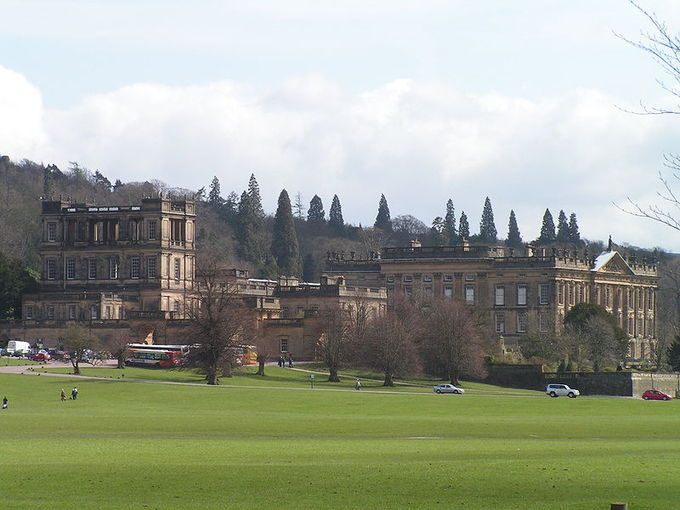
Chatsworth Firm, England: English language Baroque architecture, every bit seen in Chatsworth Business firm, tin can be characterized by heavy structures adorned with elaborate ornamentation; however, information technology tends to be relatively evidently, with more than Classical subtleties, compared to the Baroque architecture of the continent that was being built at the same fourth dimension.
French Architecture in the Bizarre Period: Versailles
The Palace of Versailles was built during King Louis 14's reign and contains 700 rooms, extensive gardens, and lavish decoration.
Learning Objectives
Identify the most impressive features of Versailles and those artistically responsible
Cardinal Takeaways
Central Points
- The Palace of Versailles was executed in the French Baroque style , characterized by its large curved forms , twisted columns , high domes , and complicated shapes.
- The architect for the palace was Louis Le Vau, the interior decorator was Charles Le Brun, and the landscape designer was Andre Le Notre.
- Interior design from this menses is known every bit Louis Fourteen style. Originated by Le Brun, it is characterized by richly woven carmine and gilt fabrics or brocades , heavy gold plaster molding , large sculpted side boards, and heavy marbling.
- The gardens at Versailles cover virtually 2,000 acres of country and were executed in the French formal garden style, or jardin a la francaise.
- Notable features of the palace include the Hall of Mirrors and the Grande Canal.
Central Terms
- parterre: A garden with paths between flowerbeds.
- brocade: A thick, heavy fabric into which raised patterns have been woven.
- molding: A plane or curved narrow surface, either sunk or projecting, used for decoration past means of the lights and shades upon its surface and to conceal joints, especially between unlike materials.
Overview: Versailles
The Palace of Versailles is an opulent palace built by Louis 14 that contains 700 rooms, all-encompassing gardens, and lavish decoration. Initially a pocket-size hunting lodge built past his begetter, Louis XIV transformed Versailles with four intensive building campaigns over his reign. The formal aesthetic of the palace was meant to glorify France and show the power and greatness of the self-proclaimed Sunday King, Louis Xiv. The architect for the palace was Louis Le Vau, the interior decorator was Charles Le Brun, and the landscape designer was Andre Le Notre. These three artists had worked together previously on the private Chateau Vaux le Vicomte for the king'southward minister of finance before he was imprisoned. In 1682, Versailles was transformed into the official residence of the king, and such notable features of the palace as the Hall of Mirrors and the Grande Canal were built.
The Fine art and Artists of Versailles
The Architecture: Louis Le Vau
The Palace of Versailles was executed in the French Bizarre mode by architect Louis Le Vau, a French Classical architect who worked for King Louis XIV. French Baroque architectural style is characterized by its big curved forms, twisted columns, loftier domes, and complicated shapes. In comparison to the Baroque compages of the balance of Europe, it is commonly thought to be more restrained and characterized past its mixture of lavish details on symmetrical and orderly buildings.
The Interior Design: Charles Le Brun
Charles Le Brun was the interior decorator for the Palace of Versailles, equally well as get-go painter to the king. Louis XIV declared Le Brun the "greatest painter of all fourth dimension," and Le Brun worked on such notable features of the palace as the Halls of War and Peace, the Ambassadors' Staircase, and the Swell Hall of Mirrors. Interior design from this menstruum is known equally Louis Fourteen style, originated by Le Brun, and was characterized by richly woven red and golden fabrics or brocades, heavy golden plaster molding, large sculpted side boards, and heavy marbling.
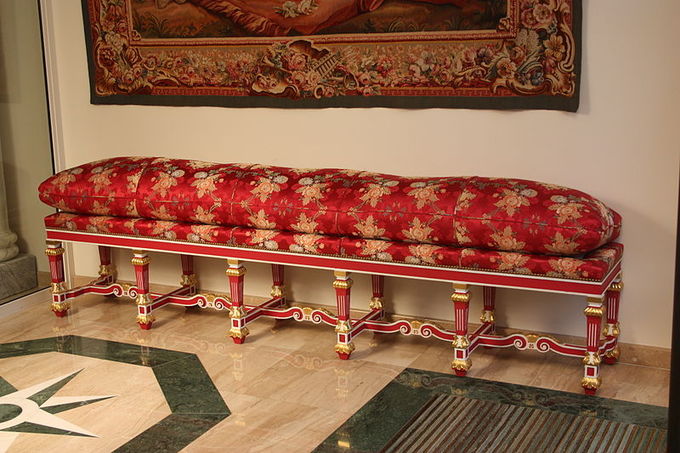
Louis XIV style: This elaborate demote showcases the style of Louis Xiv at Versailles, which is characterized by richly woven red and gold fabrics or brocades, heavy golden plaster molding, large sculpted side boards, and heavy marbling.
The Hall of Mirrors is the cardinal gallery of the Palace of Versailles and is one of the most famous rooms in the earth. The main characteristic of this room is a series of 17 mirrored arches that reflect 17 arcaded windows overlooking the gardens. Each arch contains 21 mirrors. The arches are stock-still between marble pilasters upon which bronze symbols of France are embedded.

The Hall of Mirrors: The main feature of the Hall of Mirrors is a series of 17 mirrored arches that reverberate 17 arcaded windows overlooking the gardens. Each arch contains 21 mirrors.
The Gardens: Andre Le Notre
The mural blueprint at the Palace of Versailles is one of the near extravagant in history. Headed by Andre Le Notre, the gardens at Versailles cover virtually 2,000 acres of land and were executed in the French formal garden fashion, or jardin a la francaise. This style is characterized past its meticulously manicured lawns, parterres of flowers, numerous fountains, and sculptures.
A common feature of sculpture and ornament at Versailles is the use of classical mythology equally apologue . The Bassin de Latone was designed by Le Notre and sculpted past Gaspard and Balthazar Marsy between 1668–1670. This fountain depicts scenes from Ovid'south Metamorphoses, chosen as allegories to revolts during the king'due south reign. The Bassin d'Apollon is some other fountain that depicts the lord's day god driving his chariot to light the sky. The Grotte de Thetys is a freestanding structure with an interior decorated in elaborate trounce-work to correspond the myth of Apollo.

Gardens at Versailles: Plan for the improvident gardens at the Palace of Versailles.
The Grande Canal is a notable feature of the gardens, with an impressive length of 1,500 x 62 meters. King Louis XIV ordered the construction of "little Venice " on the G Canal, which housed yachts, gondolas, and gondoliers received from Venice. It also served a functional purpose by gathering the water that tuckered from the fountains and redistributing it to the gardens by horse-powered pump.
The Grande Commande is a series of 24 statues that were deputed by Louis XIV to decorate the gardens. The statues illustrate the classic quaternities (sets of iv) at the time of the Four Humors, the Four Parts of the Day, the Four Parts of the World, The Four Forms of Poetry, the Four Elements, and the Four Seasons. Four additional sculptures depict abductions from classical mythology.
Source: https://courses.lumenlearning.com/boundless-arthistory/chapter/architecture-of-the-baroque-period/
0 Response to "What Is a Characteristic of Baroque Architecture? Art in World Cultures"
Post a Comment