Learning to Read With Clues to Meaning Ann Staman
If you've taught Pre-K, Kindergarten, or first form, you're probably very familiar with patterned texts. You know, the level AA or level A books where the same sentence or phrase is repeated on each page, similar this one:
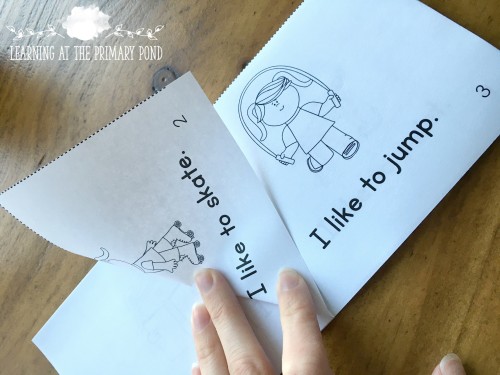
These books tin can be valuable for emergent readers (students who are but kickoff to learn how to read). To be able to read one of them, a child doesn't even need to have mastered all her alphabetic character sounds. If you help her read the pattern (the words that echo), she can use picture clues to "read" many of the other words in the text.
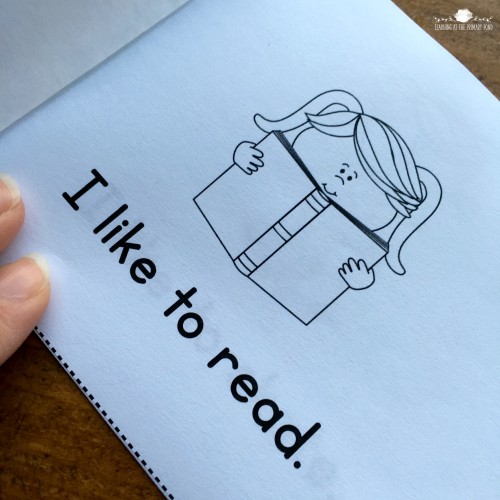
For instance, on the page below, the moving picture conspicuously shows a child reading. If the child already knows that the residue of the words say "I similar to," she can use the picture to figure out that the "additional" discussion says "read."
On other pages, the movie may not immediately requite away the unfamiliar give-and-take. In the example beneath, the child would probably accept to employ the showtime letter of the alphabet (h)and look at the motion picture to read the word "hug."
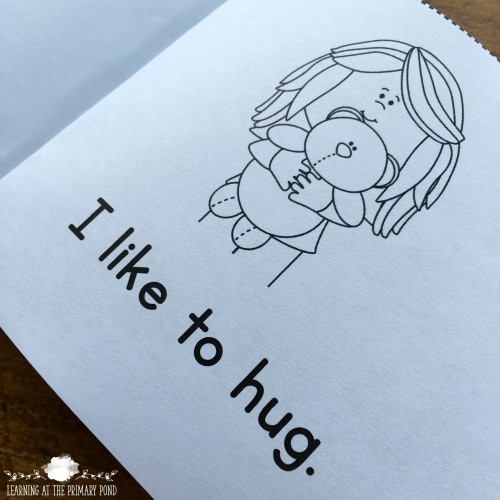
Having to use the commencement letter and the pic is the "work" in the book – the place where the child is challenged to apply her learning to do some "real" reading.
And as yous can probably gauge, there really isn't all that much "piece of work" in a Level A text – just a couple of places where the child really has to use her letter sound knowledge and/or sight word noesis to read the words.
The simplicity of patterned texts is useful because it:
- Allows students to practice concepts most print, similar pointing one-to-i and reading left to correct
- Helps kickoff readers develop conviction and offset to view themselves as readers
- Allows students to practice their developing cognition of letter sounds, sight words, and reading strategies
However. At that place is a "but" to all this.
Patterned texts tin be very misleading to students. If students spend months reading Level A text, many begin to believe that this is what reading is – guessing at the words, relying heavily on the pictures, and repeating the same sentence on each page. And that, of course, is not what reading is really all nigh.
Patterned texts are particularly problematic for students with either a) weak oral linguistic communication skills or b) very stiff oral linguistic communication skills.
Students with weak oral language skills (or English language Language Learners) often accept a difficult fourth dimension reading these patterned texts, regardless of how much alphabetic character sound knowledge they have. The premise of these texts is that students will be able to "read" many of the words simply by looking at the picture. Simply if a child sees a flick of "cherries" and does not know what they are chosen, she is non going to exist able to read the word "cherries." Nor is she going to be able to decode the discussion. Even though this is a beginning level text, the word "cherries" starts with a digraph (ch) and has a long vowel sound at the end, spelled by "ie." If a child is reading at Level A, she is not going to take mastered these two spelling patterns yet.
In addition, students with poor oral language skills or ELLs may struggle to "option upwards" the design of the book. Even if the instructor tells them the design, they may forget it as they go through the book considering the structure is not familiar to them. And since merely some of these words volition be decodable, students tin can't admission those words if they don't remember the design. For these students, a text that is supposed to exist relatively piece of cake becomes full of challenges that are out of achieve.
On the other paw, students with very strong oral language skills may read those beginning texts with 100% accurateness by relying too heavily upon their stiff vocabularies. When a student knows immediately that the fruit in the picture is called a "raspberry," in that location's no demand for him to employ whatever letter sound knowledge. In add-on, these students hands pick up the blueprint of the volume. Their strong oral language skills make remembering and repeating the blueprint a cinch.
In turn, this may give united states of america, their teachers, the incorrect impression that these students are stronger in their letter sound noesis and decoding skills than they really are. And again, reading these types of texts for besides long may crusade these students to develop a skewed concept of what it ways to read.
Although patterned texts present challenges, y'all don't need to go dump your Level A books in the teacher'south lounge with a sign that says "Free." 😉 I hateful, I write patterned books – on TpT and through a publishing visitor.
We just demand to be aware of the challenges that these books nowadays, and take steps to ensure that students don't get "stuck" in texts that practice not require much "existent" reading. Here are some things that you can practice to move students across patterned texts:
- Gradually decrease the amount of support you lot provide in helping students read the pattern. When I get-go children in Level AA/A patterned texts, I mostly "requite" them the pattern. I tell them exactly what the repeating phrase is on each page, and I show them how to read it. Afterwards a couple of weeks, I mention the pattern a couple of times during our pre-reading conversation, but I no longer read the words on the page for them. (Example: We are reading a volume called Shapes that has the blueprint "I see a ____." Before I give the children their books, I say, "Let's await at the cover. I see a star. What do yous run into, Jenny?" and so prompt Jenny to utilize the phrase "I see a ____" to respond. In this example, I'm not showing students the actual text that says "I see," only I'thou putting the linguistic communication "in their mouths" so that they are able to access the pattern.) Eventually, I don't tell them what the pattern is at all – although I may indicate out any super tricky words. Students so have to use their decoding skills to figure out more than of the words than if I had outright given them the pattern.
- Play "Cover Upward The Picture."Once a child or group of students has read a patterned book, explain that now you are going to cover up some of the pictures. Their job is to figure out what the folio says, even without the picture clue. You can either fold dorsum the page (if the words and text are on different pages) or use a sticky note to prevent the children from seeing the picture. Have them read the pattern and so use the first few letters of the word. This forces students to focus on the print, rather than relying solely upon the picture. And my intervention students call up that this is the BEST "game" ever!
- Use more phonics texts / decodable readers. Decodable readers are different from leveled books. They "force" kids to use their phonics knowledge, because the words cannot be guessed entirely from the pictures. While I'm non a huge fan of decodable books that are nonsensical or lack meaning, A) there are some great decodable texts out there, and B) they tin can exist incredibly powerful in helping kids acquire what reading is all about.
- Put students in Level B books even if the data does not indicate that they are "ready" nonetheless. For the most role, I wait until students can read a text with 95% accuracy or above before moving them upward to the next level. All the same, I don't abide by this "dominion" when moving students from Level A to Level B texts. If a pupil has been reading Level A (patterned) texts for a couple of months, and so it'south time to motion on. I pull out a Level B text (which typically has less of a pattern) and effigy out what supports I need to put in place in society to help her exist successful with the book. Do I need to pre-teach vocabulary? Perchance go over a phonics pattern before starting? Exercise an repeat read first? I've found that if I choose the right scaffolds, a child can read a Level B text even if she is not ever reading Level A texts with loftier accurateness. You lot can also alternate Level A and Level B texts, a strategy used by Fountas' and Pinnell'sLeveled Literacy Intervention plan.
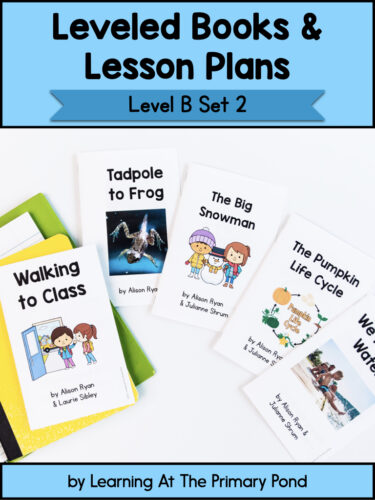
If y'all need Leveled Readers, bank check out the sets in my TPT shop. They are available in print, digital, or a print and digital combination to meet your electric current needs. Each set includes 5 books and accompanying lesson plans!
The lesson plans are ready-to-teach and include suggestions for a book introduction, comprehension questions, strategy instruction, and follow-up activities for phonological awareness, phonics, high frequency words, etc.
Do yous accept any strategies for helping students "make the jump" out of patterned books? Or practise you have any students currently "stuck" in Level A? Please comment beneath – I'd love to hear from you!
Source: https://learningattheprimarypond.com/blog/the-problem-with-using-patterned-books-to-teach-children-how-to-read/
0 Response to "Learning to Read With Clues to Meaning Ann Staman"
Post a Comment